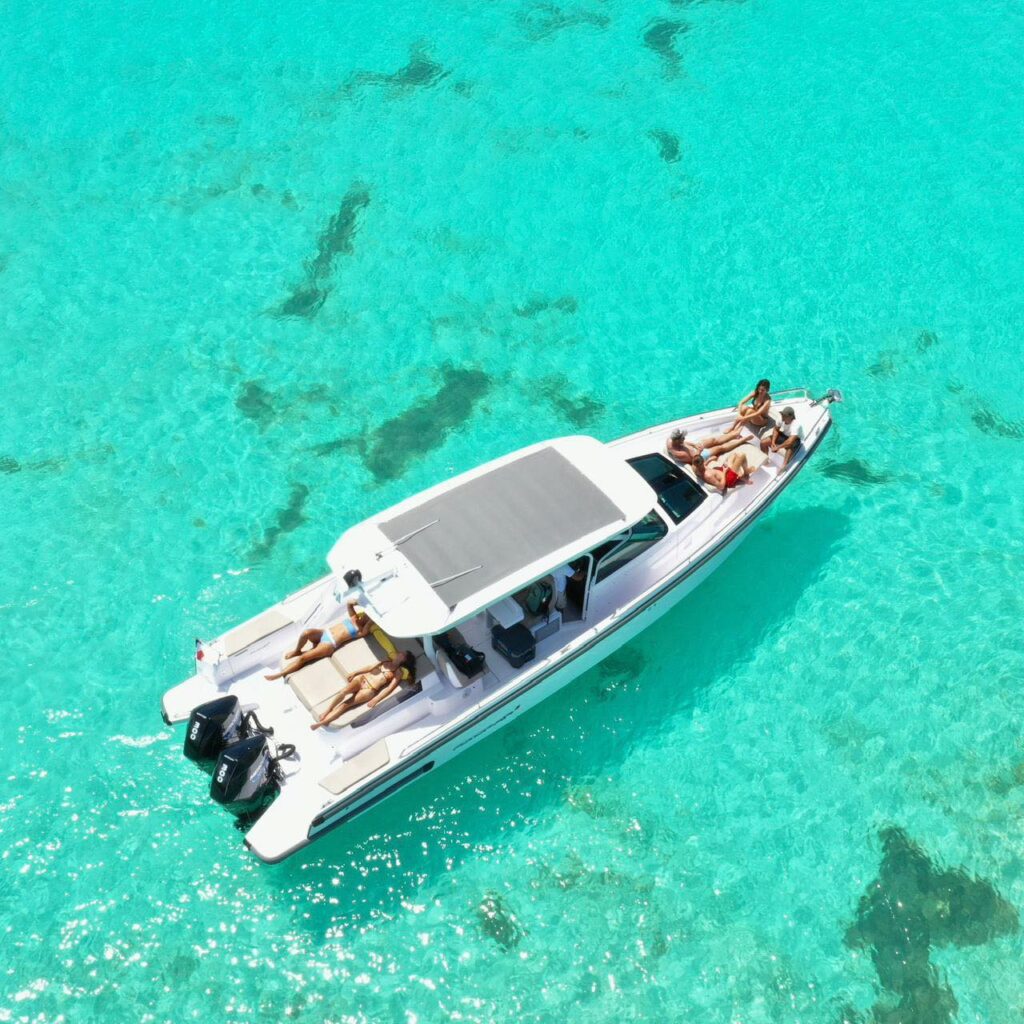
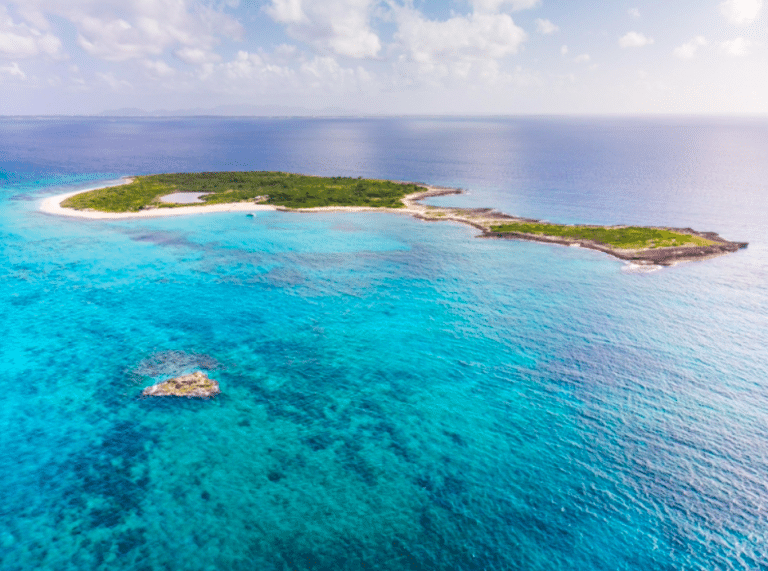
There are the beaches in Saint-Martin where you park the car, and then there are the others. The ones that only appear once you have left the coast behind: an uninhabited islet where turtles feed at the foot of the boats, a bay you can see from Orient Beach and never walk to, a whole island that empties out at 4:30 pm when the last shuttle leaves.
These six can only be reached by sea, or very nearly. Here is what you will find there, how to get to each one, and what you should know before casting off.
Key takeaways
- Tintamarre is the one beach in Saint-Martin no shuttle serves: 25 to 30 minutes from Anse Marcel, turtles at the anchorage and two beaches to yourself.
- Caye Verte (Green Cay) is the Saint-Martin islet you can see from Orient Bay and cannot walk to, ringed by one of the healthiest reefs on the island.
- Îlet Pinel is the Saint-Martin beach with a public ferry, but the island only really opens up after 4:30 pm, once the last boat has gone.
- Creole Rock is the best snorkelling site in Saint-Martin: you do not land on it, because everything worth the trip happens below the surface.
- Petites Cayes is the Saint-Martin beach with no road access, two and a half hours along a coastal trail or a few minutes from Anse Marcel by sea.
- Happy Bay is the only one of these six Saint-Martin beaches outside the Nature Reserve, where anchoring is free whatever the size of the boat.
Tintamarre Island: How to Get There and What to Do
Tintamarre is an uninhabited island classified as a Nature Reserve, 25 to 30 minutes by boat from Anse Marcel. No shuttle serves it: the only way in is a private boat, which is why you often land there without meeting anyone.
You feel the difference on arrival. Where the beaches you can drive to fill up by ten in the morning, Tintamarre belongs to whoever treats themselves to the crossing. The boat picks up its mooring, the engine stops, and all that is left is the sound that gave the island its name: waves working the reef, the tintamarre sailors heard before they ever saw land.
Boats moor in Baie Blanche, the wide bay facing Saint-Martin and the reason people come. The sand is a hard white against the turquoise, and the bottom shelves so gently that you can walk out for tens of metres with the water at your waist. This is where sea turtles feed all year round, often a few metres from the boats.
A couple of fin strokes from the mooring, off the northern point, lie the richest waters on the island: coral, schools of fish, rays resting on the sand. You put on a mask from the swim platform and you are there. On the far side, a footpath crosses the island in a few hundred metres and comes out on a second, wilder beach that most visitors never see. Bring closed shoes and allow twenty minutes on foot for a complete change of scene.
The island still carries traces of its past. Its airstrip closed in 1952 and nobody has lived here since. A few remains can still be made out in the vegetation. Tintamarre is now the only nesting site of the brown noddy in all of Saint-Martin, a protected bird that abandons its nest at the slightest disturbance, and the Reserve simply asks that visitors keep the place quiet.
- Best for snorkelling, sea turtles, complete quiet
- Access private boat only, no shuttle service
- From Anse Marcel 25 to 30 minutes
- Mooring Reserve yellow buoys, vessels under 15 metres
It is precisely because the site is protected that you do not come here on any boat: the Nature Reserve restricts its buoys to vessels under 15 metres, and only authorised boats may moor. Most of our fleet is, from the speedboats to the catamarans. What remains is choosing the one that fits your group and the stops you want to link together in a day.
Turtles at the anchorage, the snorkelling spot off the back of the boat, the second beach to yourselves. Tell us what you want to see and we will handle the rest.
Caye Verte (Green Cay): The Islet Off Orient Bay
Caye Verte is a protected islet of 5.3 hectares lying off Orient Bay, 20 to 25 minutes by boat from Anse Marcel. You can see it from the busiest beach on the island, and no path leads to it.
It may be the most frustrating beach in Saint-Martin, and that is exactly what makes it worth the trip. Thousands of people look at it every day from their sun loungers, a few hundred metres away, with no way of getting there other than a boat. Those who do cross in a few minutes and find themselves on a strip of sand with nobody on it.
The islet is a raised limestone coral plateau tilted gently from north to south, and it is classified because brown boobies and tropicbirds nest on it. The rule that follows is worth knowing before you set off: you do not land on the islet itself, but the western beach lies outside the reserve boundary and landing there is permitted. That is the beach to aim for.
The real show is underwater. The protected reef running along the islet is open to snorkelling and diving, and the site just east of Caye Verte is among the best regarded on the coast. Fishing is banned here, so the marine life develops freely, and you notice it the moment you put your head under.
- Best for reef snorkelling, underwater photography, a beach with nobody on it
- Access boat only, landing on the western beach only
- From Anse Marcel 20 to 25 minutes
- Mooring 2 buoys, untenable in a northern swell, no overnight
A word on timing, because it matters here more than elsewhere. The Nature Reserve states plainly that the anchorage at Caye Verte becomes untenable in a northern swell. A good captain looks at the sea before committing to the stop, and switches to Tintamarre or Pinel if conditions do not allow it. That is exactly what a private day charter gives you: a plan B decided the same morning.
Îlet Pinel: The Ferry, the Beaches, and When to Go by Boat
Îlet Pinel is the only one of these six beaches served by a public shuttle, running from Cul-de-Sac: around 10 euros or 12 dollars return, every 20 to 30 minutes, five minutes of crossing. The Nature Reserve notes that the island becomes deserted again at 4:30 pm when the last boat leaves, and as early as 4:00 pm in low season.
That sentence from the Reserve tells you everything. Pinel has two faces, and the shuttle only shows you the first.
By day it is the busiest islet in Saint-Martin: two restaurants with their feet in the sand, sun loungers, a lively beach atmosphere. If your plan runs to three hours on the main beach with lobster at lunch, the shuttle does the job perfectly.
But Pinel has three beaches, not one. A 1.5 km footpath links them, dotted with information panels and two orientation tables that identify the surrounding islets. Nothing stops you walking it from the landing stage except the clock: between waiting for the shuttle, the walk out and back, and the last boat, the day shortens fast. Arriving by sea, you anchor straight off whichever beach you have chosen. A marked underwater trail completes the picture below the surface.
And then there is the end of the day. At 4:30 pm everyone leaves and the island changes character: the same beaches, the same water, nobody on them. It is also the moment you can weigh anchor for Tintamarre or Caye Verte, or simply stay. That is what a full-day charter makes possible.
A note on navigation: Pinel has no mooring buoys, anchoring is on sand only, and the Nature Reserve warns that the approaches to the islet are tricky. Captains who work these waters year-round know the pass. To the west, the small islet of Petite Clef serves as a roost for seabirds: you pass alongside it, you do not land.
- Best for families, snorkelling, lunch on the sand, a quiet end of day
- Access public shuttle from Cul-de-Sac, or private boat
- From Cul-de-Sac 5 minutes by shuttle
- Mooring no buoys, anchoring on sand only, no overnight
Pinel after 4:30 pm, when the last shuttle has gone and the three beaches empty out. We set the outing around the timing that suits you and around what the sea is doing that day.
Creole Rock: Saint-Martin’s Best Snorkelling Site
Creole Rock is a protected islet lying off Grand Case, reachable only by sea. The Nature Reserve prohibits landing on it, and that hardly matters: everything the site is known for happens below the surface.
It is the most highly regarded snorkelling site on the French side, and it owes that reputation as much to its layout as to its marine life: the water is shallow, the rock cuts the wind and the swell, and the bottom stays visible throughout. Complete beginner or certified diver, everyone gets something out of it.
On the Grand Case side the current is weak and the water clear, which makes it the ideal side for a first outing with mask and snorkel, with dozens of fish species a few metres from the edge. On the Anguilla side the water deepens and the current picks up, and that is where experienced divers go looking for barracuda, parrotfish, coral and occasionally turtles. Rays settle on the sand, lobsters wait under the rocks.
Above the waterline, the rock is a pelican roost and a nesting site for brown boobies and tropicbirds. You approach it, you go around it, you do not climb it.
Its position makes it an obvious stop rather than a destination: Creole Rock sits on the way to Pinel and Tintamarre, which makes it the first or last swim of a half-day charter along the north-east coast. Thirty minutes here stay with you for a long time.
Boats moor on the buoys installed by the Reserve, restricted to vessels under 15 metres, and engines are shut off within 30 metres of the shore. That is the price of the silence and the clarity of the water.
- Best for snorkelling, a first dive, marine life
- Access boat only, landing and climbing prohibited
- From Grand Case a few minutes
- Mooring Reserve buoys, under 15 metres, engines off within 30 m
Petites Cayes: The Beach With No Road Access
Petites Cayes, which surfers call Wilderness, has no road access. You reach it along the Froussards trail, 4.5 kilometres in two and a half hours according to the Nature Reserve, or in a few minutes by sea from Anse Marcel.
It is a beach of two extremes. On foot you earn it: a narrow, rocky path crossing the last intact coastal forest on the island, trainers required, water to carry, and both hands free on the technical sections. Those who walk the full trail pass the Tête à l’Anglais cactus, recognisable by its bright red spiny crown and endangered worldwide, cross an entire beach made of coral polished smooth by the sea, and come out at Pointe des Froussards with Anguilla in view.
By sea it is another story. The same beach, the same absence of people, but with the cooler, the towels and the snorkelling gear. And no trail to walk back before the light goes.
What both versions share: there is nothing on site. No bar, no shade, no shop. The sand is wide, the sea works this northern coast, and the spot draws surfers when the swell comes in. It is raw coastline, inside the reserve boundary, where collecting plants or wildlife is prohibited.
From Anse Marcel it is the closest stop for a speedboat, and the easiest to slot in early in the day before heading for Tintamarre.
- Best for wild beach, surf when the swell is up, coastal hiking
- Access Froussards trail on foot, or by sea
- From Anse Marcel a few minutes by sea, around 30 minutes on foot
- Mooring no facilities, site within the reserve boundary
Happy Bay: The Quiet Beach on the West Coast
Happy Bay is the only one of these six beaches outside the Nature Reserve boundary. Anchoring is free, with no vessel size limit and no permit to apply for, a few minutes by boat from Marigot.
Let us be honest on one point: you can also walk there. A path leaves the northern end of Friar’s Bay and takes 10 to 15 minutes in flip-flops. This is not an unreachable beach.
What it does not have is everything else. No bar, no vendors, no loungers, no facilities. And that is exactly why you find yourselves in small numbers here when Orient Bay is full. The sand is wide, the water calm, the hills run down to the beach.
For a day at sea, Happy Bay has a status of its own. Every other stop in this guide imposes something: a boat size, a buoy, a landing ban. Here, nothing. It is the one on the list a good-sized yacht can take without checking anything first, and the natural anchorage for a lunch stop or a late afternoon on the west coast, on the right side of the island for sunset.
- Best for lunch anchorage, late afternoon, sunset
- Access boat, or a 10 to 15 minute path from Friar’s Bay
- From Marigot a few minutes
- Mooring free, outside the Reserve, no size limit
What the Nature Reserve Rules Mean for Your Boat
The Réserve Naturelle Nationale de Saint-Martin covers 3,060 hectares, of which 2,900 hectares are at sea. Two of its sites have organised moorings, Tintamarre and Creole Rock, both restricted to vessels under 15 metres and 15 tonnes.
The table below sets out what applies at each stop. The rule that matters most in practice: two sites have buoys and two do not, which shapes the order of a day on the north-east coast more than anything else.
| Site | Moorings | Limit | Fallback anchoring | Overnight | Landing |
|---|---|---|---|---|---|
| Tintamarre | Yellow public buoys, 3 white for dive clubs | 15 m / 15 t | Boats under 10 m, on sand, 20 m from shore | Regulated | Allowed |
| Creole Rock | Yellow public, white for professionals | 15 m / 15 t | Not provided for | Not provided for | Prohibited |
| Caye Verte | 2 buoys per local sources | 35 ft per local sources | Sand only | Prohibited | West beach only |
| Îlet Pinel | None | Not applicable | Sand only | Prohibited | Allowed |
| Petites Cayes | No organised mooring area | Not applicable | Not applicable | Not applicable | Allowed |
| Happy Bay | Outside the Reserve | None | Free | Free | Allowed |
The right boat depends on your stops as much as on your group. Tell us where you want to go and we will tell you what can get there.
Planning Your Day: Marinas, Routes and Season
Beauty Charters runs around 50 private boats from three marinas, Marigot, Anse Marcel and Simpson Bay, and has been chartering in Saint-Martin since 2005. Anse Marcel serves the five stops on the north-east coast. Happy Bay, on the west coast, is reached from Marigot.
The north-east coast day, from Anse Marcel. Petites Cayes to open, Creole Rock for the first swim, Tintamarre for the long beach stop and lunch, Caye Verte if the sea allows, then Pinel late in the afternoon once the shuttle has stopped running.
The west coast half-day, from Marigot. Happy Bay, no reserve constraints, for a lunch anchorage or an end of day facing the sunset.
Season. December to April brings calm seas and the best underwater visibility, and it is also the busiest stretch. Humpback whales pass through the reserve’s waters between January and May. Sea turtles are there year-round, around the islets and along the eastern coast.
What to bring. Water, food, reef-safe sun protection, closed shoes for the trails on Tintamarre and Petites Cayes. Apart from Pinel, none of these stops lets you buy anything. Pets are not allowed in the reserve.
When to book. Two to four weeks ahead is usually enough, four to eight in high season or for a group of ten or more.
For the wider picture of what a day around the island covers, see our Saint-Martin destination page. If you would rather cross to another island, the day trip to Anguilla takes twenty minutes.
Frequently Asked Questions
Is Pinel Island worth visiting?
Yes, Pinel Island is worth visiting, provided you pick your moment. The main beach is busy during the day, with two restaurants and sun loungers. The island’s two other beaches, and the late afternoon once the last shuttle has left, offer a very different experience.
How much does it cost to go to Pinel Island?
Going to Pinel Island costs around 10 euros or 12 dollars return on the public shuttle from Cul-de-Sac. The crossing takes about five minutes and boats leave every 20 to 30 minutes.
Is Pinel Island cash only?
The shuttle to Pinel Island is bought directly at the dock, in cash, with no online booking. Bring change before you set off, as there is no cash machine at Cul-de-Sac.
Is there a ferry to Tintamarre Island?
No, there is no ferry to Tintamarre Island. The island is uninhabited and no scheduled service runs to it: access is by private boat or charter only, 25 to 30 minutes from Anse Marcel.
Can I snorkel at Tintamarre Island?
Yes, you can snorkel at Tintamarre Island. A site sits a few fin strokes from the anchorage in Baie Blanche, off the northern point, and ranks among the richest waters on the island.
Where can I swim with turtles in Saint-Martin?
You can swim with turtles in Saint-Martin mainly at Tintamarre, which the Nature Reserve describes as a favoured feeding and nesting site. They are often seen a few metres from the boats at the Baie Blanche anchorage, all year round.
What are some secluded beaches in Saint-Martin?
The secluded beaches in Saint-Martin are Tintamarre, Caye Verte, Îlet Pinel and Creole Rock, all reachable only by sea, along with Petites Cayes, served only by the Froussards trail, and Happy Bay, which has no facilities despite a walking path from Friar’s Bay.
Can you walk to Happy Bay?
Yes, you can walk to Happy Bay: a path from the northern end of Friar’s Bay takes 10 to 15 minutes on foot. Happy Bay has no facilities, which is why it stays quiet despite that land access.
Can large yachts anchor at Creole Rock?
Large yachts cannot moor at Creole Rock. The Nature Reserve restricts its buoys to vessels under 15 metres and 15 tonnes, and engines must be shut off within 30 metres of the shore. Happy Bay, outside the reserve, takes boats of any size.
Is there sargassum on the beaches in Saint-Martin?
Sargassum in Saint-Martin varies with the season, the currents and how exposed each beach is. The east coast, where Pinel and Caye Verte sit, is more exposed than the west coast. It is one of the things a local captain checks the same morning: if one anchorage is affected, the day shifts to another.
What is the best time of year for a boat day in Saint-Martin?
The best time of year for a boat day in Saint-Martin runs from December to April: calm seas, steady wind, the best underwater visibility. Humpback whales pass through the reserve’s waters between January and May. June is still pleasant with fewer people.
Your stops, your timing, your boat for the day. Quick reply guaranteed.